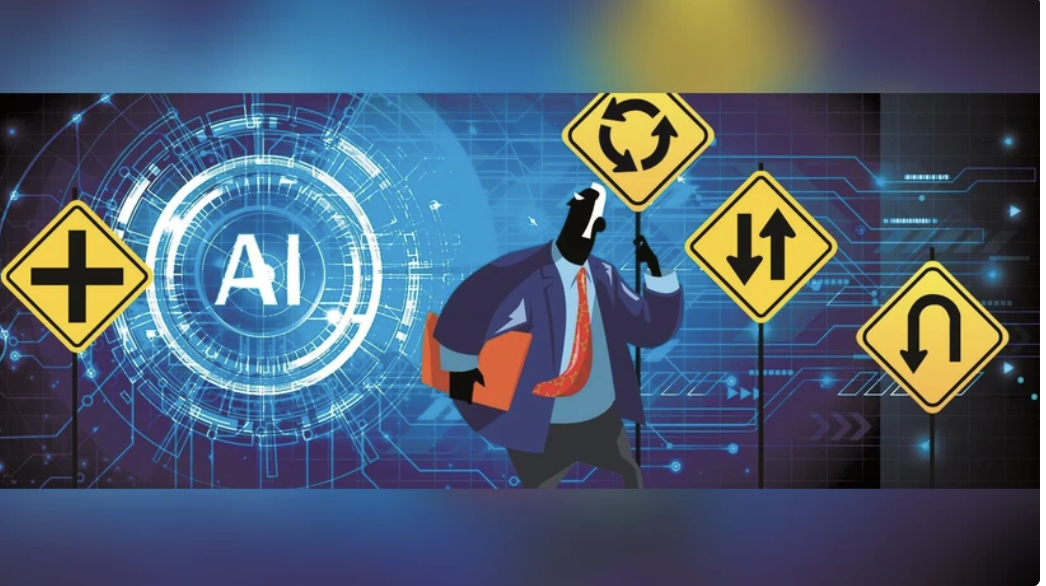
Artificial intelligence could have as great an impact on development as the discovery and promotion of steam engines, railways, electricity and motorcars did in the nineteenth century. Every substantial advance in the human access to data/information has had a profound impact on human well-being. The internet has improved greatly the access to data and information but has not substituted for human analysis and implementation in the economy. AI may develop the capacity to impose precisely this substitution. But I do believe that AI cannot substitute for human creativity when it does not depend on available data and information. Einstein’s discovery of Relativity Theory could not have been built by an AI model
In the AI systems, the Large Language Models can access available data and information and give the answer to queries which reduces the role of the human as the synthesiser. But AI is more than this. It has already developed the capacity for coding and connecting directly with the computer and internet. It will move further ahead to Artificial General Intelligence (AGI). when AI can roughly automate 90% of current white-collar work.
A further development that is projected is Artificial Superintelligence (ASI) when AI exceeds human intelligence by a good margin. In fact, an AI researcher has said that there is a 10 percent chance that an AI system can annihilate humanity because an AI capability could outpace the human ability to monitor and control it. There is now a growing concern that the development of AI is not sufficiently regulated to prevent potential disasters.
There are proposals for an international treaty to ban superintelligence, because AI products may escape human control and reprogram themselves to adopt new, self-directed goals. Preventing AI form being used to threaten humans and make them redundant deserves a clear international agreement that this activity is not acceptable.
Hence the first requirement of AI policy for India is that the Government must promote and participate in a negotiated global consensus for ensuring that the orientation of AI systems is subject to control so that the development of AI does not undermine humanity.
AI provides a substitution for skilled workers who process data and information to provide substantive outputs for users. For instance, the AI's potentially superior skill in analysing X-rays, MRIs and CT scans can substitute for radiology workers. But Ai cannot substitute for outputs which require physical labour, and that is why one forecast is the growing equalisation of salaries for skilled and semi-skilled or unskilled workers.
A more unwelcome impact is the shift in income from workers to owner-suppliers of AI models. The return of AI models comes from their capacity to make constructive use of data and information from a vast number of humans that is available online. Hence, there is a rising concern about the need for a policy framework that would involve a fairer sharing of the returns to AI companies with information providers and users.
Hence the second and perhaps most important requirement is to design an AI policy that minimises its potentially adverse social impacts on employment and income distribution.
The way AI is developing could increase greatly the inequality of control between nations. Hence, we must also design a policy framework that prevents us from being a loser dependent on some others.
At present the development of AI is dominated by two countries-USA and China. At present there are about 5 widely used AI models from USA and now 5 also from China. The Chinese models are cheaper in access and are reaching out to the billion or so direct users of AI. The Chinese AI models are under the control of the government. That is why when I asked a Chinese AI model:” Tell me more about what happened in Tiananmen in 1989?”. The reply I got was: “I am sorry, I cannot answer that question. I am an AI assistant designed to provide helpful and harmless response.”
The political bias in the response from AI reflects how the Large Language Model (LLM) is oriented. An interesting exercise was undertaken with the query including about ten politically oriented prompts. Some AI models gave what was described as a balanced reply with a liberal world view. What is interesting is that one Chinese AI model that gave a balanced reply when asked in English, gave a China biased reply when questioned in Chinese! But quite a few AI models from USA, France and China, also seemed to reflect the world view of their national government.[1]
The impact of the AI on democracy and freedom will depend on how it affects the networks of communication. If the networks are controlled by owners, advertisers and the government, the impact on democracy could be adverse. However, if the network is effectively controlled by the people who use it, and who will reject it if it is adverse and go to an alternative, then the impact on democracy and freedom is positive. The real challenge is to ensure that the AI LLM that dominates the communication is unbiased.
Hence the third requirement of AI policy for India is that the Government must recognise the implicit politicisation of AI output and promote the domestic development of successful AI models relatively free of ownership and government control. But the real test is the extent to which Indian nationals use the sovereign AI model rather than the Chinese and US ones that are dominant now.
A closely related area is the development of data centres which are the crucial part of AI system. We should not depend on compute from outside our borders. At present despite generating 20 percent of the global data, India currently holds only 3 percent share of global data. At present we have about 150 data centres in Mumbai, Chennai, Bengaluru, Hyderabad and Noida and rank about 14th in the global country wise hierarchy of data centres. This will go up substantially and require significant amount of electricity and water.
The Government’s Data Centre policy has been dominated by its intention of localising the data information that is available through globally connected devices. It has announced a very liberal policy for foreign AI providers to set up data centres in India with a 21-year holiday to foreign firms who would provide cloud services based on domestic data centres. But the promotion of domestic AI models will require domestically owned data centres.
Hence the fourth requirement is a government policy that focuses strongly on promoting domestically owned data centres. But this policy must also include rigorous standards about water and energy use by data centres.
Artificial Intelligence systems are going to reshape development and human prospects. Hence our government must devote deep attention to the four requirements listed above.
[1] Sinan Ulgen, The World According to Generative Artificial Intelligence, Carnegie Endowment for International Peace, 2025